A Brief History of the Celts (Brief Histories) by Ellis Peter Berresford
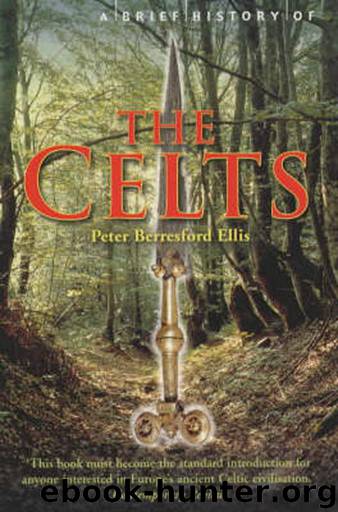
Author:Ellis, Peter Berresford [Ellis, Peter Berresford]
Language: eng
Format: azw3
ISBN: 9781472107947
Publisher: Little, Brown Book Group
Published: 2013-02-06T16:00:00+00:00
The Vedas and Upanishads show that the Hindu year was indeed divided into two halves in a fashion analogous to the Celtic year. The Vedic references, such as the Bhadaranyaka, indicate that the Vedic calendar was lunar, with a variable 354/355 days, included intercalary months and followed a thirty-year cycle like the Celtic one. Plutarch mentions a thirty-year festival among the Celts when Cronus (Saturn) entered the sign of Taurus.
It is clear that by the first century AD the majority of the Continental Celtic peoples had adopted the new forms of astronomy and astrology that were used in the Graeco-Roman world. These had emerged from Babylonia into Greece and thence to Rome. The older methods used by the Celts, once common to Indo-European society, were swept away. Evidence for the pre-Graeco-Roman (Babylonian) concepts appears in fragmentary form in early Irish cosmological writings.
Pliny refers to the reputation of Gaulish Celtic astrologers in the first century AD. But by the time they emerge into historical scrutiny they were, as Hippolytus tells us, using the Graeco-Roman forms. We know that Favorinus of the Volcae Arecomii, born in AD 80, had a reputation in the Roman world for his astrology. The Aedui astrologer Caecilius Argicius Arborius, of the third century AD, was another astrologer of note and he drew up a birth chart for his grandson, the poet Decimus Magnus Ausonius of Bordeaux. We know this from Ausonius’ Parentalia in which he also tells us that Arborius was of the Druid caste. Perhaps the name Arborius, linking him with sacred trees, is an indication of this connection?
Another Celtic astrologer was Anthedius, a friend of the Gaulish Celtic bishop, Apollinaris Sidonius. And a fourth-century Gaul wrote a Celto-Latin comedy play entitled Querolus (Complaint) whose main character is a Celtic astrologer named Mandrogente, meaning ‘born of a horse’. The Roman biographer Flavius Vopiscus observed drily that ‘superstition based on astrology always prevailed over the Celts’.
It is from the sixth century AD that we begin to find a wealth of written evidence from the insular Celts concerning cosmology. From it we find that Irish cosmology falls into four historic phases. The pre-Christian phase, of which we have only fragmentary knowledge, indicates that the Celts shared the Indo-European knowledge of numerology, astronomy and astrology which emerges in the Vedas. Then, as the Celtic world entered the Christian period, the new Graeco-Latin learning arrived from Babylonia. In the earliest Irish evidence, the cosmology shows the influence of the Alexandrian Claudius Ptolemy, second century AD, whose teachings on astronomy and astrology were accepted until the arrival of Arabic influences and the work of Copernicus. From the eleventh century, the Irish astronomers and astrologers used the Arab forms which had entered Europe.
In Britain there is a sculpture showing the zodiacal signs dating from as early as the third century AD. It was found in Housesteads, at the northernmost edge of Roman influence, and is now in the museum at Newcastle on Tyne. One of the earliest surviving texts in old Welsh is a tenth-century discussion about the zodiac which is called seraul cichol.
Download
This site does not store any files on its server. We only index and link to content provided by other sites. Please contact the content providers to delete copyright contents if any and email us, we'll remove relevant links or contents immediately.
| Africa | Americas |
| Arctic & Antarctica | Asia |
| Australia & Oceania | Europe |
| Middle East | Russia |
| United States | World |
| Ancient Civilizations | Military |
| Historical Study & Educational Resources |
The Daily Stoic by Holiday Ryan & Hanselman Stephen(3322)
The Fate of Rome: Climate, Disease, and the End of an Empire (The Princeton History of the Ancient World) by Kyle Harper(3067)
People of the Earth: An Introduction to World Prehistory by Dr. Brian Fagan & Nadia Durrani(2738)
Ancient Worlds by Michael Scott(2688)
Babylon's Ark by Lawrence Anthony(2679)
The Daily Stoic by Ryan Holiday & Stephen Hanselman(2575)
Foreign Devils on the Silk Road: The Search for the Lost Treasures of Central Asia by Peter Hopkirk(2464)
India's Ancient Past by R.S. Sharma(2454)
MOSES THE EGYPTIAN by Jan Assmann(2417)
The Complete Dead Sea Scrolls in English (7th Edition) (Penguin Classics) by Geza Vermes(2283)
The Earth Chronicles Handbook by Zecharia Sitchin(2229)
Lost Technologies of Ancient Egypt by Christopher Dunn(2226)
24 Hours in Ancient Rome by Philip Matyszak(2084)
Alexander the Great by Philip Freeman(2065)
Aztec by Gary Jennings(2030)
The Nine Waves of Creation by Carl Johan Calleman(1917)
Curse Tablets and Binding Spells from the Ancient World by Gager John G.;(1862)
Before Atlantis by Frank Joseph(1854)
Earthmare: The Lost Book of Wars by Cergat(1825)
